Friday, April 28, 2017

Labored Confusions

In the dim squalor
of sweatshops
tucked behind silhouetted skyscrapers – glittering
blood diamonds on black velvet – the rhythmic thundering of hammers,
and little heartbeats stolen
from forgotten schoolyards,
sound the trumpets of neoliberalism.

Gucci, Armani, Tiffany’s, Ivy Leagues and Standardized Testing materials;
and in the hollowed out shells of heavy ordinance,
Imperial Democracy nurtures
The better angels of our nature — buy two, get one free.

Inertia

The way the days pass,
with tired breaking of
Insincere Promises;
while the unending retrospections
of a cognizant mind,
Despair
at its reluctant inertia.

Primate Saturday: Jane & Her Chimps

You know what  who I have always been jealous of? Scientists who have found a life-long obsession vocation — Diane Fossey in the mountains of Uganda, Galdikas in Borneo, and of course, Jane Goodall in Tanzania! I wonder, often, how fulfilling it must be to be able to chase down your scientific curiosities throughout your life with such consistency!


Golden Age Comics: With A Twist

Superhero comics are, supposedly, fun! Right? Except when you really think about it, they are not. When you read them in a historical and political context, they are blatantly sexist, discriminative, privilege-perpetuating pieces of propaganda garbed in bright colors and designed to distract people from their undertone. And it works! As Edward Bernays knew all too well, if you can serve a piece of addictive substance — video games, comics, TV in general — with some nice packaging, and if you can make sure that consuming it doesn’t require any active cognitive exercise, then soon you will develop an addicted population who, not unlike tobacco-addicts, would not only come to rely on the substance but would defend it with fervent zeal. To ensure that the process didn’t become too apparent it is necessary to present an appearance of avant-garde — grown people reading comics, adults pushing buttons on a keyboard and making like it takes intelligence to play video games, parents watching cartoon with their children — while quietly reinforcing all kinds of stereotypes under the hood. Take the Golden Age comics for instance. Not only are the gender stereotypes, and socio-political ones, silently reinforced through the
aesthetic
cosmetic and behavioural traits of the characters (all neatly divided along  gender lines), but the same are also the guiding principles behind what each character is allowed, and not allowed, to say.
So, in the spirit of Direct Action subversion of cultural imperialism in order to pursue Social Justice and Gender Desegregation, here’s some twisted takes on the Golden Age comics from yesteryears! 

Friday, February 17, 2017

Primate Saturday: Cocoa with Koko

For over almost half a century, Francine "Penny" Patterson has claimed that her surrogate daughter, a female western lowland gorilla named Koko, can use sign language productively. Following what started as her own PhD project, Koko has gained international publicity due to both the public's fascination with a domesticated gorilla that clearly interacts (but not necessarily linguistically communicates) with humans, and also due (largely) to what most scientists consider to be over-inflated claims by Patterson regarding Koko's sign language usage.
To be sure, no one has ever claimed that Koko cannot use signs to signal certain elemental concepts that are interpretable by humans. For instance, gorillas have long been known to be capable of complicated social structures, intricate inter-personal relationships and of a wide range of emotions. Given this, Koko's ability to use the sign for "sad" or "cry" on being shown pictures that would qualify as such, after extensive familiarization with the concerned sign-reference correlations, is hardly news to any primatologist. Patterson's claims, however, go far beyond this ability (often also observed in bonobos and chimpanzees) -- according to Patterson, Koko instinctively uses signs to communicate her feelings and thoughts. The ability to use discrete symbols, and to recursively combine them to create ever more complicated structures with semantic content, is a hallmark of the human species. And while Patterson does not, in fact, claim that Koko is quite that adept, her claims of Koko having self-consciousness, or being able to recognize herself in her reflections/creating a self-identity, and using sign-language to "think" about her world has consistently raised eyebrows in the scientific community. Several scientists have pointed out that Patterson is falling victim to the one cardinal sin in ethology -- anthropomorphism. She has been compared to an over-zealous mother who is infatuated with her very clever baby, and is thus ascribing to the behaviours of the baby concepts that are, developmentally, beyond the baby's ability. According to most, Patterson's interpretations of Koko's behaviors vanish when seen through more objective eyes.
While Patterson's claims about Koko's abilities are very likely to be overreaching, she has nonetheless to be commended for spending her entire life caring for the gorilla she adopted. Certainly this deserves more praise than Project Nim, wherein the researcher who adopted a chimpanzee, named him Nim Chimspky (after the polymath linguist Noam Chomsky), and tried to teach Nim sign language, would eventually give him up for a life in captivity when the research didn't go as expected. Nim, having been raised in a human family, was unable to adapt to wilderness later on. He lived out the remainder of his life, following the sad (but predictable) demise of Project Nim, being subjected to various forms of experimental indignities, including being used for product testing -- a confused, troubled and perpetually depressed chimpanzee, Nim died in his cage, forgotten and abandoned by the world that had moved on to the next circus trick.
There are important lessons to be learned from both Project Nim and Koko. The positive lesson is one of hope; we are only gradiently removed from our closest cousins with whom we share a majority of our genetic materials, who only lack may be one or two of our qualities, but are nonetheless very as capable of appreciating us as we them. The other lesson, though, is one of a more cautionary note; just because our cousins in the ape world lack our kind of language neither makes them lacking in consciousness, nor does it do to invade their world and try to teach them neat circus tricks in vain and misguided attempts to improve on evolution.


Sunday, February 12, 2017

Unrelenting

Slow, dull, monotonous, persistent
and unforgiving;
Every beat renews
the ever darkening constancy
of a reluctant pessimist.

An exercise in futility;
rusting arteries can only
blacken young blood,
with each new beat.
Slow;
Dull;
Unrelenting;

Never learning.

Mockingbirds do not return
to leafless branches
and play Muse
to the poets of eternal Fall.

Friday, February 10, 2017

Primate Saturday: Ham in Space

Before there was Neil Armstrong, Yuri Gagarin or Carl Sagan, there were the forgotten apes we sent to space. Whether such acts reflect human anthropocentrism, or whether they were worthwhile sacrifices for furthering our understanding of the cosmos, is an open debate. No one, of course, in their right minds would claim that we should not have studied the space. The survival of our species, and since we alone are capable of Scientific logic probably the survival of other earthlings, depends on our understanding of deep space. So, perhaps, instead of arguing against the space-faring chimpanzees, we should look back on their experiences, and remember the sacrifices they made (involuntary as they were) to further our understanding of the cosmic ocean. So, in remembering the most humane of the astronomers, I dub thee Sagan's Primates.

The Story of Ham


Friday, February 3, 2017

In All Fairness

Forked-tongued, mousse haired, black tied 
Cretins
whistle hawkish tunes,
circling the bodies of Syrian children
washed up on Bodrum shores,
singing war songs,
beating battle drums.

Lying, stealing, pillaging,
boundary-challenged savants,
talk of walls and borders.

And from the heights of Standing Rock,
drenched in the blood and tears
of an once proud People,
Fair Evil eyes the Earth;
looking, searching, lusting
for another Wounded Knee.

Primate Saturday: Mutual Aid Apes

Bonobos share 98.7% of our DNA. Physically, they resemble chimpanzees. But something remarkable sets them apart from their primate cousins, making them an altogether different animal. Bonobos live in almost complete absence of violence; work cooperatively toward shared goals; foster a society that values equality; and engage in prolific casual sex. Could these gentle, promiscuous creatures hold the key to a world without war? Vanessa Woods, author of Bonobo Handshake, discusses what we might learn from our evolutionary relatives with anthropologist Brian Hare and NPR RadioLab's Jad Abumrad.


Wednesday, February 1, 2017

Primate Saturday: DIY Orangutans

This is going to be a new series in the spirit of understanding the evolution of beings that would ultimately result in higher cognition, the highest being the human ability for logical natural language (my personal area of research). We are all, of course, descendants from the same single source, but even though we share much of our genetic materials with the higher apes -- bonobos, chimpanzees etc. -- we are still separated by a very tiny subset of cognitive abilities when compared to the higher primates. These abilities, often abstract computational in nature, must nontheless be explained as biological endowments, which in turn require an evolutionary (thought not necessarily adaptationist) explanation.

This series, though, is not so much meant to be an in depth elaboration of the concerned science as it is meant to be food for thought... How did we get here, with our abilities to do mathematics and write poetry, and engage in all sorts of abstractions, starting with the simple, yet revolutionary, ability to imitate and use tools?
                                     David Attenborough: BBC Earth's Amazing DIY Orangutans


Wednesday, January 11, 2017

Epilogue to Identity Politics

Barrack Obama is almost out of the White House, and boy!, did he have some Call-of-Duty-styled fun with the world during his time in power! And the saddest bit is that this hawkish, lying, totalitarian goon will only look saintly in comparison to the utterly bigoted lunatic white supremacist who is to follow him. But let's stay focused on Barry for the moment.

We all remember the moment he was elected, the tears in the eyes of the aging civil rights warriors who had lived through Jim Crow and segregation, the old women of color who were grandmothers before they earned the right to vote, and we understood why it mattered to them. Even as we were scared of the inevitable bane of identity politics, even as we knew deep in our hearts that when you pick from a pack of wolves you can only ever pick another wolf, even so we couldn't help but give in a little to the magnitude of "change" in the fortunes of a people, even if it was purely symbolic. But fast forward eight years, and what do we have? The "change" that we could believe in is nowhere to be seen, either in domestic or in foreign affairs of Barry's regime. But lies, deceits, coups, assassinations and incarceration of dissent as far as the eye can see.

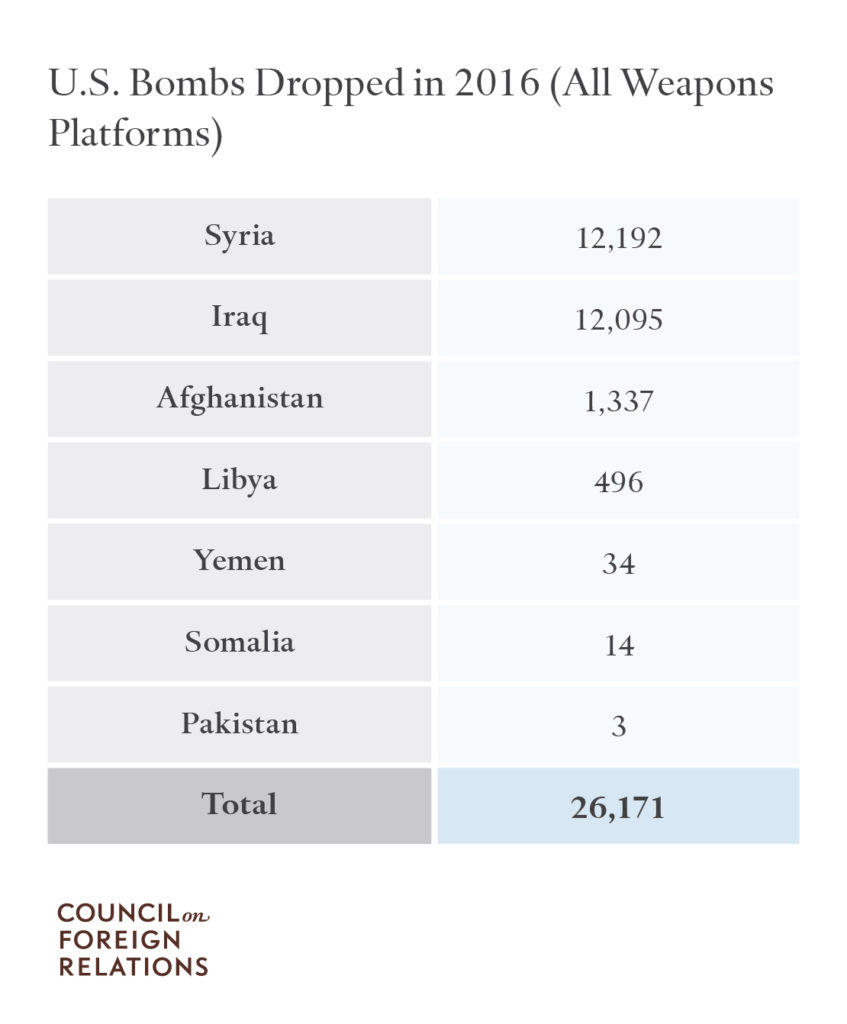
Kafka once wrote, "Suffering must lead to something elementally beautiful", and much in a Kafkaesque fashion we hoped that a man who came from a long suffering people would know not to further suffering of others. What we got, though, was a black elite who carried out the most extensive surveillance campaign at home, persecuted whistle blowers using an Espionage Act drafted in 1917, stayed silent in the face of a white supremacist police state carrying out genocidal violence against his own people, and abroad engaged in the most extensive drone assassination and terror campaign the world has ever known. Here's a chart from the Council on Foreign Relations on exactly how much 'HOPE' and 'CHANGE' Barry brought to the world, disguised as heavy munitions, in 2016 alone!
cfr_us_drones_011017-847x1024

In fact, looking at the chart above one would wonder, isn't Barry doubly responsible for his crimes against humanity because he used the color of his skin to not only trick a desperate population into believing he was their "hope" for a "change" from his predecessors, but also stole a Nobel Peace prize? For being black! While he silently watched the tacit exploitation and murder of the same black people, on whose shoulders he stood to claim a Nobel prize, by a brutal and biased police force resorting to Jim Crow era tactics! Barry may look black, but he has never lifted a single finger to help the conditions and lives of those whose legacy he has instead exploited to further the imperialist cause. Heck, the man even gave a speech at the Nobel Peace ceremony justifying war! Words befitting a man whose philosophical ruminations involve "moral standards in waging war". How strange it is how strange the world turns out to be, as Jerry Fodor once wrote.

Ask yourself, "How many people did each one of those bombs kill?"  If we assume a medium death toll per bomb of, say, 10 people each, then the United States has killed a quarter of a million people in the last year alone. If the number is very large, then it is an atrocity that rivals the worst ones ever committed in the history of humanity. And yet, Barry wins a Nobel Peace Prize, and Steven Pinker is singing hosannas for the long democratic peace. We are at peace, apparently, yet a single country has probably killed more than a quarter of a million people in just the last one year. In a saner world, the sheer paradox would drive a moral man to insanity. And to the observant ones, this truth is not that hard to comprehend either.


This should hardly be news, if it wasn't for the fact that we live in a media-controlled nation where public intellectuals are replaced with prime-time talk show hosts and unfunny comedians making placid observations about the world that fail to challenge the status quo in any kind of an informative manner. As Noam Chomsky, one of the last remaining iconic intellectuals, once said, "The smart way to keep people passive and obedient is to strictly limit the spectrum of acceptable opinion, but allow very lively debate within that spectrum....”. And Chomsky falls outside that spectrum. In an interview with Washington based history teacher Dan Falcone and New York based English teacher Saul Isaacson, 'the most important intellectual alive' discussed the issues of drone warfare, terrorism, and Washington's long legacy in indulging in genocidal games, group/identity politics and exceptionalism.
"Yeah, Reagan started it. It’s pretty interesting. I mean terror became a big issue when the Reagan Administration came in. They immediately announced [their plans] and kind of disparaged Carter’s alleged human rights programs. The main issue is state-directed international terrorism. Right at that time that big industry developed. That’s when you start getting the academic departments on terrorism. You get UN conferences trying to define terrorism. Journals, you know, big explosion of interest in terrorism. I started writing about it more at that time as did Ed Herman. But we actually had been writing about it before and we picked up after that.

But the stuff that we write can’t enter the canon for a very simple reason. We use the official definitions of terrorism. The definitions in the U.S. code, in British law, in U.S. Army manuals and so on. And if you use those definitions it follows instantly that the United States is the leading terrorist state in the world. So since you can’t have that conclusion you have to do something else. And if you look at all this academic work in the conferences and so on there’s a constant theme that terrorism is extremely hard to define and we therefore have to have a deep thinking about it. And the reason it’s hard to define is quite simple. It’s hard to find a definition that includes what they do to us but excludes what we do to them. That’s quite difficult. So it takes a global war on terrorism.

The worst terrorist crimes going on right now are the drone campaigns. But you can’t include that obviously. So you have to try to define it. I mean if Iran was carrying out an assassination campaign killing anyone around the world who Iran thought might harm them someday we’d go crazy. But that’s the drone campaign.

There’s been a big problem now, for 35 years, in trying to define a way to restrict the concept of terrorism to things that those guys are doing to us. Take a look at the Supreme Court decision that just authorized an effort by U.S. claimants against Iran for terrorist acts. What are the terrorist acts? The terrorist acts are bombings of U.S. military installations in Lebanon and Saudi Arabia, which Iran is claimed to have something to do with. Well suppose they did. That’s not terrorism. I mean if we have a military base in Lebanon that while we’re shelling Lebanese naval ships, the Navy is shelling Lebanese installations and somebody attacks [that’s not terrorism].

But that’s the way you’ve got to craft the concept and it runs right through the whole ideological system. Kind of interestingly one of the exceptions is the international law community. So there’s an interesting review article in the latest issue of the American Journal of International Law, a very conservative journal, which basically does, or comes pretty close to calling the drone campaign terrorism. But it’s not in the mainstream of course or in the textbooks.

In fact if you look at Reagan’s global war on terrorism it very quickly turned into a massive terrorist war: [by us] Central America, South Africa, the Middle East, all U.S.-backed terrorism. That’s one of the reasons why it disappeared from history and why the standard line is that Bush 43 declared the war on terror. Actually he just repeated what Reagan had said 20 years earlier."

The interview is illuminating and insightful, and serves as a stark reminder of the troubled legacy of identity politics that we cannot afford to forget just because of Trump. There are lessons to be learned here, and especially so when the time comes for us to react to whatever destruction and devastation Trump will leave us with! If we pay attention to history, and listen to public intellectuals like Chomsky, may be we won't make the mistake of indulging in identity politics when reacting to the Trump-era like we made when reacting to 'dubya'.

Monday, January 2, 2017

Cold Turkey

You ever wandered,
inside your own head?
Aimlessly?
Heedlessly?
Like a drunk hobo in Kansas?

There's a feeling --
I can't find --
lost in my head. Endlessly
It itches
Where I can't scratch.

Thursday, December 22, 2016

A Make-Believe Poem

Seaside autumn evenings seep
between the yellowing pages
of an old journal --
And rustling,
the winds of used deskfans
smell of sub-continental summers past.

Tuesday, December 13, 2016

Sour

This and that... and those;
sundry remnants of little summer indiscretions
      -- they build up on you! 
Hunched over, fat, sweating in sleeveless vests;
Sort and shuffle, and burrowing through
little stacks of procrastinations,
and lotto tickets, paperback Kerouac and playboys;
Murmurs of the lost summers
of his youth.

2nd Street

Sometimes, she wonders
if Dreams are just fragments
of fear and desperation?
            Shaped, sanded, and molded.
Neat little blocks
of antediluvian uncertainties.

Out on long walks --
         the kind that's good for the soul --
Sometimes, she had thought of Love;
seeping out from behind tiny suburban windows,
where tired old wives
fight off their beer-crazed husbands.

Thursday, November 3, 2016

For Noam Chomsky: On his 88th Birthday!


Thinking of you, old friend...
Thinking of our first meeting;
In a dark corner of a dusty library,
your voice first enthralled me --
Speaking from 1959, you endowed
the mind with ideas that shatter orthodoxy. And yet,
so radical in their comprehensibility.


In a trance, I returned the next day,
To that dusty corner, in 1967.
You were there! And you spoke
of responsibilities in ideas;
And I promised to always try...

Thursday, October 27, 2016

For Noam Chomsky

Among other things,
thanks for explaining how
the many palettes of deceit paint
different masks for
The Truth.

Among other gifts,
thanks for the undeniable...
Courage in comprehensibility.

Tuesday, June 14, 2016

Neoliberalism: A Ghost Story

"How do they bear my weight?", I wonder...
Standing in silent depression,
Memories of bygone centuries weighing down
On their rocky shoulders.

They watch the water under the bridge;
As a great serpentine stream,
Struggles to wash it all.
All the lies, all the filth and all the accumulated waste of Progress and Development.
And neoliberalism colors the waters of Ganges.

I sit on the shoulders of giants;
Behind me a metropolis' heart beats,
Down in the sewers, and the gutters, and the slums;
Where its dearest families live.
And in front, ghost of an once voluptuous river;
Stinks of methane and gasoline.


The First Naxal: Initial Impressions of Kanu Sanyal's Authorized Biography and a First-Person Look inside the Naxalite Revolution

It seldom happens that the story of an individual becomes so intertwined with the cause she or he stands for, that it becomes impossible to separate one from the other. Kanu Sanyal's is one such rare story. To read it is to relive the history of the Naxalite Movement (since 1965), which the Indian establishment calls "the country's biggest internal security threat", even as its poorest and fringe-marginalized desperately hang on to the same movement as their last resort.

This book narrates the making of Kanu Sanyal right from his childhood to the days of the Naxalbari Uprising (in the mid-'60s), and then traces the historical development well beyond the confines of the tumultous '60s right down to India's great foray into neoliberalism in the 1990s. Supposedly, the last great decade. It delves deep into Sanyal's evolution as a Marxist-materialist (as opposed to Bolshevik Communist) rebel and throws light on the various stages of the Naxalite Movement, starting with the Naxalbari Uprising, with relevant background information, and then continues on to trace the effects of the uprising, and the reactions to it, on the current political environment in India's untold reality. 

In short, much more than a historical retelling The First Naxal is also a brutally honest indictment of the heady subcontinental flavor of neoliberalism, aka 'India Shining', that gripped the Indian economy in the early 90s like yellow fever, leading the "sovereign socialist secular democratic" State down a path where like a thirsty vampire it sucked out the nation's core resources (its rivers, forests, mountains, and the people who depended on these natural resources) and like a sick street-dog vomited it out in its many glittering malls and supermarkets -- 'India Shining', in tinfoil wrapped American-conceived, Chinese-sweatshop executed, mass-manufactured trinkets, made out of the very flesh of an ancient land, and soaked in the blood and dreams of its poorest and disenfranchised. Unlike most works on sociopolitical commentary, however, this book does the public service of explaining the present in its proper historical context. 

The Poet once wrote,

                                                "Each slow turn of the world carries such disinherited,
                                                   To whom neither the past nor the future belong."

This book details a brave and unapologetic uprising of those disinherited who, devoid of a past and denied any future, plunged headfirst into an armed revolution against an unforgiving State Machinery in a desperate attempt to stop the civilized, moderate middle-class from stealing the last crumbs of bread off of their banana-leaves plates. And the merciless repression they faced in the form of the ire and anger of the patriarchal Indian State, and the apathy and indifference of a 'shining' moderate, liberal middle class that is so comfortable in its negative peace of "no noise" that it didn't think to blink even once as an entire race of people were, and still are, slowly being pushed to the brink of extinction. Kanu Sanyal's is a story not just of a forgotten (albeit very much alive) people's revolution, but also of the genocidal nature of a Brahminical State steeped in caste-ist bigotry and a sense of entitlement to privilege. 

Just as much it is a story of an apathetic, blissfully ignorant, media-addicted, consumption-driven, shine-fascinated middle-class that seems more and more comfortable with the idea of the aforementioned State Patriarch, so long as the State acts as the vanguard of their distorted morality. Keep the poptarts flowing into their LG microwaves, and they will happily ignore mass genocide while they Boldly watch the Beautiful on a 43 inch plasma screen television mounted on their bottle-green painted Parisian-plastered wall -- the proud sons and daughters of Friedman's loopy Free Market. Other than poptarts, microwaves and plasma screens, the story of the middle class, however, has remained the same even as the decades have rolled by. From the 60s, through the 70s and right down to the 90s, The First Naxal and the first naxal tells us of our own sad origins. We The People.

As one reads through the pages of this book -- rather ordinary use of the English language to effectively paint in words one of the most extraordinary times in recent history -- it is not hard to understand the circumstances that made a former school teacher (mastermosai, in vernacular) in one of the more rural areas of West Bengal reach the conclusion that "eliminating individual class enemies -- police officers, university teachers, bankers, and politicians from both the left and right -- in open daylight, for all the moneyed class to see" is the only way to perfect social justice. Nor is it difficult to sympathize with the urban Naxalites -- an entire generation of mostly upper-middle class, higher educated, urban youth, who dropped out of India's most elite colleges and universities, denounced paternal inheritance, and picking up arms brought to life one of the bloodiest decades in Indian history, nearly wiping out the bourgeoisie in Bengal. And just as easy is to shiver at the sheer violence with which the Indian State reacted towards its own children -- and children they really were, most naxalites. The average age of these "internal terrorists" -- in dealing with whom Indira Gandhi, then Prime Minister of India, declared "democratic niceties have no place in civil war" (Maggie Thatcher must have been proud of her former Trinity bestie), and under whose expert orders Siddhartha Sankar Roy, then Chief Minister of Bengal, unleashed the most brutal form of "torture and execute" operation in West Bengal -- was eighteen.

One wonders, reading the story of Bimal, a twenty-one year old student from Jadavpur, who was hung upside down and had a hot iron inserted in his rectum at the express order of Somen Mitra, the anti-Naxal spearhead of the Congress party in Bengal -- routine interrogation during the Naxal days in Bengal -- how many Bimals were tortured and executed by the State from 1967 to 1975? How many enemies of class war did the Bimals of the day execute? The numbers are lost somewhere between government lies and rebel re-tellings, leaving behind shattered families and a forlorn dream. And Sita Mashi (Aunt Sita) who, ninety seven years old now, still sits on her khatiya (a sort of hammock-like bed made out of wood and ropes) and tells anyone who would listen where she used to boil rice for her son, Anish, and where the police took him to be shot, behind a public urinal, and how he touched her feet before he was dragged away.

But who has time to listen? Out in the streets of Calcutta, oops Kolkata (the State wants to rewrite its colonial past, and recolonize the land on its own now), busy teenagers cross the roads absorbed in their iThings, and the malls fill up daily with boys and girls still in school uniforms. Bimal and Anish's dream, however, lives on in India's Red Corridor, where the State sponsored genocide also still continues. An endless cycle of violence; the Naxals kill cops, the cops wipe out tribal villages, the villagers blame the naxals, the naxals kill some villagers, and in Jadavpur University Paul Krugman recently gave a lecture on the Efficient Market Hypotheses. Adam Smith must be rolling around in his grave, even as the Ghost of Marx looks on in dismay, as Sita Mashi sits on her khatiya, slowly swaying back and forth, and keeps retelling old stories of Anish coming home from school, how old he would be now, and how she would rock her grandchildren on her knees if Anish was alive and married. She has never heard of Kanu Sanyal. But she remembers Anish, in his last days, used to say Inquilab Zindabad (Long Live the Revolution), and shows an old black-n-white photograph of Malcolm X to the reporters who show up once in a while, and wonders out aloud if it's a picture of  one of Anish's classmate. "He was very fond of the picture", she says.

                                     Amar chele-ta je   kothay gelo?
                                     my       son  def.art  where go
                                   Where did he run away, my son?

What is significant about this book, other than the deeply touching stories of people whose lives were forever changed by the Naxalbari Uprising, is that this is the only authorized biography of Kanu Sanyal in any language - he personally read and cleared all its chapters but the last one, which deals with his aberrant demise. On March 23, 2010, The First Naxal hung himself in his home in Seftullajote village. They say his body was broken from the three years of police torture he endured in the '70s, he suffered from a painful heart condition and was disillusioned at the murder of innocent villagers by some naxals in Madhya Pradesh and Chattisgarh recently.


One wonders, what would Sita Mashi say, if she ever met this man who so moved her son to take up arms and sacrifice his life for a just cause (even if one debates the just-ness of his methods)? Or heard of his demise? And what ghosts haunted Kanu Sanyal in his last days? Was he wrong in calling for a revolution? He did express remorse, in his later years, for having fueled an armed rebellion without laying enough ground work. But was an entire generation wrong to dream of a fairer future? Did they have to be slaughtered like animals? (Perhaps, as Noam Chomsky would say, For Reasons of State.) Is there a cure for the neoliberal onslaught that even today threatens India's, and the world's, poorest?

The State seems determined to push the justice-minded into another Naxalbari Uprising, and the State itself is now more powerful, more fearsome in its oppressive abilities, than it has ever been. Must the roots of Progress and Development be watered with our blood? Is this the nature of Imperial Democracy -- buy one, get one free? Can we sit still, as our mountains, rivers, forests and our flesh and blood, our friends, brothers, sisters and lovers, and all of their cumulative hopes and dreams are put up for sale by the highest bidder in the Free Market? Are we to let charlatans like Steven Pinker tell us that The Better Angels of Our Nature  have come forth, that violence is on the decline in the best of ages in human history, even as we sink deeper in debt for wanting education and neoliberalism claims our very souls for its war-machine, and the State claims sole monopoly on violent methods? Are we to let Christopher Hitchens tell us to obey the Good Capitalists as they create minimum wage jobs for our children? Are we to let Sam Harris convince us that Arab commandos are terrorists, and Israeli terrorists are commandos? Is it only terrorism when it's done to them, and is it counter-terrorism when they do it to us? Are we to sit on the sidelines of history and watch our lives and future being bottled-up by Nestle, shrink-wrapped and sold in Walmart, and still not answer the call of Kanu Sanyal? 

The author Arundhati Roy once wrote:

"The irony has never really left me -- the government's genocide in India's Red Corridor is carried out in the name of Progress and Development, and the Turkish Government's special wing that carried out the Armenian Genocide was called The Committee for Progress and Development. Who is progressing? Whose development? I can never tell."

 Neither can I. Neither could Kanu Sanyal. Nor Anish, nor Bimal. Certainly not Sita Mashi. Perhaps that's what led an eminent Bengali poet to write:

                              aamar bari,  tomar  bari
                               my     home  your  home
                             sobar       bari       Naxalbari
                           everyone's home     naxalbari


We have a choice to make, I think. Kanu Sanyal, and the history of Naxalbari and the Naxals, teaches us a very important historical lesson.We can obey the State and Make America (or India, or Pakistan, or <insert name here>) Great Again. Or we can try to Make Israel Palestine Again. We can Make Kashmir Independent Again. We can Make Nagaland Naga Again. We can choose to live on our knees, or die on our feet. It is a hefty choice, to be sure, not to be made in a fit of emotional turbulence. But it is a choice, nonetheless. They made theirs -- Kanu Sanyal, Malcolm X, Bimal and Anish. Right or wrong, unlike Nixon's non-existent Silent Majority they made a loud and clear choice, they were the Vocal Minority. We must make ours.

Inquilab Zindabad


Friday, March 4, 2016

USERNAME: EVIE -- A.I., Consciousness, Reality, Simulation and Identity in Joe Sugg's Graphic Novel Debut (A Spoiler-Free First Look)

Reading Sugg's very first book, which just happens to be a graphic novel, was a rather personal experience for me. The twenty-something year old Sugg does an excellent job of tackling certain rather interesting contemporary existential issues arising out of where the world is headed with recent developments in Artificial Intelligence, studies of the brain and the mind, and their implications for the human condition in general, and he does so while telling a very gripping and relate-able story. As someone who has been writing for a while, I can vouch that this is no small feat. Sugg deserves high praise for this very time-worthy volume, that will take an hour and a half, or two even, of the reader's life and leave her with quite a few ruminations for those sleepless nights. So... let's dive right in!

Like any conscientious young mind struggling with adolescence in this crazy corporate-consumerist world of ours, Evie feels alienated, lonely and at odds with the world. The loss of her mother, and her increasingly sick Computer Scientist father, adds to her growing sense of helpless fear as she continually struggles to find some sort of a human connection with her peers. But she finds only superficial frivolity, mindless consumerism, skin-deep camaraderie and groupies with more bubbles in their head than in their washing machines. Evie is at once torn between an intensely human urge to bond with another sapien mind, and her instinctive repulsion of the mindlessness of her peers, and they in turn respond to Evie's lack of superficiality and herd-mentality in the only way they can -- with passive violence and cruelty. Evie is scared, and hopeless in the certainty that the fridge inside which she sometimes climbs in is her only true place. She only wants what she can't have -- a safe haven with some friends who can understand her. But while the world seems indifferent, one man will not stand for Evie's psycho-emotional destitute.

Unbeknownst to Evie, her father, a brilliant Artificial Intelligence expert, is determined to give Evie a safe haven. As the reality of his own failing health dawns on Evie's father, he turns his back on the embodied physical world and turns to the abstract to ensure his daughter has somewhere left to come home to when he is gone. He would simulate her a better world! A world coded and programmed from the ground up to accept, to nurture nature and to value the mind that makes Evie so very special! e.Scape -- a living, breathing Computational Dimension with just one thing to provide it any meaning and existence. Evie's mind. When Evie's father passes away before he can finish programming e.Scape, he leaves her a mutating algorithm that only requires exposure to Evie's mind to complete itself. And all Evie needs to find her haven is a USERNAME: Evie.

Inside e.Scape, awaiting the arrival of Evie, is an entire world that would derive its very essence from an alienated mind and its untapped potential. And Evie's guide to her new world, and in a way to her very own mind, is an highly sophisticated A.I. interface that takes a transgendered-transcultural form -- UNITY. Unity is meant to be Evie's encyclopedia to e.Scape. Unity has no gender, nor any race, in fact Unity probably wouldn't even exist if Evie could only lend her mind to e.Scape. Or, would Unity? Unity is a set of principles that guide e.Scape to absorb Evie's mental realities, and to reflect their immense potential back to her. But when more than just Evie arrives in e.Scape, Unity faces a choice -- should she evolve? Should Unity remain a set of principles that are designed to absorb, or should Unity now face her own computational free will and interpret what her principles mean? Are principles mere statements? If there is a meaning to principles, are they inherent to the principles? Are they a reflection of the minds that framed those principles? What parameters must a set of principles impose upon their self-intepretations? Can A.I.s have free will? Is Unity to transform her descriptive status, shed the artificial and become a true intelligence? Or will that entail a betrayal of her own computational roots? Is the programmer the limit of  the program? Or is the algorithm more than just a recipe? How is Unity to know? Is it even possible to know?